
Hi Friends,
There’s something different about this edition.
At the beginning of the year, I decided that Questing would be built around interviews, an hour with an operator, key decisions reconstructed, and something useful on the other side. That format works. But it’s also dependent on access, scheduling, and finding the right person willing to go there honestly. So I’ve been thinking about what else belongs in this publication.
Breakdowns are my answer. Same question Questing always asks: how did someone decide, under pressure, with incomplete information? But drawn entirely from what’s already documented publicly. No interview required. Just editorial judgment applied to decisions that are already on the record, told from the vantage point of the different roles closest to the call.
The research still involves operator conversations. I talk to people close to the story to pressure-test the read, close gaps the public record can't fill, and make sure the analysis holds. The difference is that the subject doesn't need to say yes for the edition to exist.
This edition is the first attempt. I’m treating it as an experiment, not a finished format, so I’d genuinely like to know what you take from it. Here’s the first one.
Six thousand users in a month sounds like traction.
In Eswatini, population 1.2 million, zero competing delivery platforms, it might just be what happens when you’re the only option. Swoop, a logistics company, took that number, raised $7.3 million, and moved to Lagos. The real test of what those six thousand users actually meant starts now.
Within months of launching, its founder, 19-year-old Aubrey Niederhoffer, had dropped out of Berkeley, accepted a $250,000 Thiel Fellowship grant, and relocated a 28-person team to Lagos. The specific bet: use $7.3 million to build a pan-African super-app, starting with food delivery, in a market where the dominant local player has two million users, four years of brand equity, and a fresh $9 million Series A, before Swoop’s own model had been validated under anything resembling real operating pressure.
The decision to move isn’t the interesting part. Every startup eventually has to graduate from its first market. The interesting part is whether the proof-of-concept actually proved anything.
The situation
Eswatini wasn’t a strategic market. Niederhoffer’s interest in the country started with GeoGuessr, and by age 15, he had built a recruiting company focused on Eswatini labour pools. The country was familiar, not a calculated foothold. For a first-time founder building a logistics product, that familiarity had real value: lower stakes, faster iteration, room to make the early mistakes that kill companies when they happen in competitive markets.
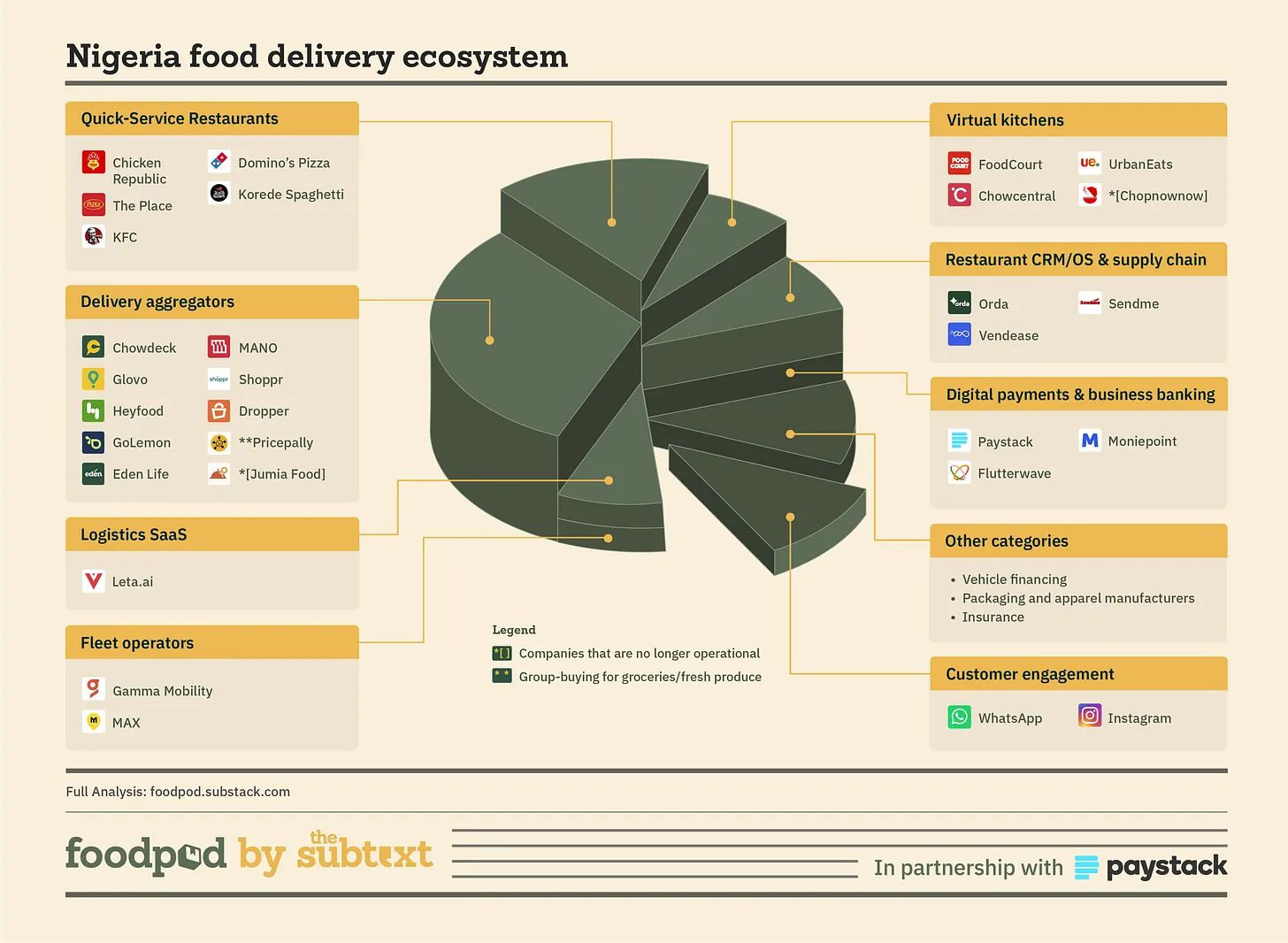
But Eswatini’s ceiling is hard. Its population is roughly the size of a mid-sized Nigerian city. Nigeria’s food delivery sector grew 187% between 2021 and 2024, according to Paystack, which processes payments for all the major players in the space. At some point, staying would stop being discipline and start being avoidance.
The question is whether that point had arrived when Swoop left or whether the investors who wrote the $7.3 million cheque decided it had. The fundraise and the Lagos move happened together, and the public record doesn’t separate them. That distinction matters more than it might seem. A founder-led bet and a capital-driven one look identical on launch day. They diverge when the model hits its first real friction.
The call
Swoop has launched in Yaba, on the Lagos Mainland, with an asset-light model: independent riders retain 100% of delivery fees, and Swoop generates revenue through restaurant commissions and a 7% customer handling fee. The fees are deliberately low; user acquisition before margin.
Its country manager, Demola Adesina, frames the target as users who aren’t currently ordering via any delivery platform, not existing Chowdeck or Glovo customers. Growing the pie, not fighting over slices. The super-app ambition goes further: groceries, ride-hailing, fintech, built on a foundation of high-frequency daily engagement.
The playbook mirrors OPay’s, which subsidised food delivery and ride-hailing to drive wallet adoption, then shut both verticals down by 2021 because they were burning cash faster than the wallet growth could justify. OPay’s wedge strategy worked. Its food business didn’t survive it. Swoop’s thesis assumes you can get the first outcome without the second. That’s the part of the plan that hasn’t been tested yet.
How the rollout team sits with this
Marketing
Users: Swoop arrives with no brand recognition in a market where Chowdeck and Glovo have had four years of it. The brief sounds simple. Reach the users nobody else is reaching: lower income, outer Lagos, ordering from local quick-service spots. In practice, this is one of the hardest acquisition problems in consumer tech. Chowdeck and Glovo almost certainly own the branded search terms for food delivery in Lagos. Any performance marketing Swoop runs goes up against an incumbent with a head start on spend and quality scores, or it goes somewhere cheaper and less proven. They’ve also scooped up the choicest out-of-home advertising locations.
The deeper problem is that “grow the pie” is a behaviour-change brief, not a switching brief. Pulling someone who has never ordered food online into the habit is slower and more expensive than convincing a Chowdeck user to try something new. It doesn’t respond to the same triggers, and the CAC assumptions built on Eswatini — where there was no competitor and no ingrained habit to displace — may not translate at all.
Restaurant onboarding: Swoop’s model only works if the right restaurants are on it. In Yaba, that means convincing supply that’s already been courted by Chowdeck and Glovo, which has four years of relationships, and likely commission structures designed to make switching uncomfortable.
The mass-market positioning creates a specific problem. The quick-service spots and buka operators Swoop wants on the platform often don’t have the operational capacity to handle a sudden spike in delivery orders. Inconsistent menus, no packaging infrastructure, no process for separating dine-in from delivery. Onboarding them isn’t just a sales conversation. It’s a capacity problem the merchant team inherits after the contract is signed.
A bad restaurant experience doesn’t damage the restaurant’s reputation on the platform. It damages Swoop’s. The merchant acquisition team owns that risk without controlling it. How they screen for operational readiness before signing, not after, will quietly determine whether the supply side holds up.
Operations
Independent riders retaining 100% of delivery fees works on a spreadsheet. In Lagos it means supply-side reliability depends entirely on people with no contractual obligation to show up, whose willingness to work is sensitive to traffic, weather, and what competing platforms are paying that day. The team has only operated in fair weather. That isn’t a minor caveat. The rainy season is when food delivery economics in Lagos get genuinely tested. It’s when a rider weighs a delivery fee against a flooded road in Ikeja GRA or Shomolu and sits it out.
The model was built in Eswatini, a small, navigable city with limited traffic complexity. Every assumption about dispatch times, restaurant onboarding, and complaint resolution is now being tested in real time in a city where the margin for operational error is thin, and the customer’s next option is one app icon away.
Customer success
This is where the gap between Swoop’s Lagos thesis and the customer’s Lagos reality shows up first. A first-time delivery customer who has a bad experience isn’t comparing Swoop to nothing. They’re comparing it to the corner restaurant they already trust. Re-engagement after a failed first order is hard, especially in a segment where trust in digital platforms is earned slowly and lost quickly.
Customer success also holds the earliest product intelligence: where orders are failing, which restaurant partners are creating problems, and what the refund rate looks like by neighbourhood. That signal is only useful if it travels clearly to whoever is making the product and ops calls. The question worth asking: how quickly can Swoop respond to the requests they’re getting from the existing customers’ channels?
These aren’t Swoop-specific problems. They’re what Lagos charges any outsider who arrives before the model is ready.
If you’re building in a constrained market and using it as a proving ground before moving to Lagos, Nairobi, or Accra, what’s the minimum it has to tell you before the move is responsible? Swoop’s answer, implicitly, is 6,000 users in a month. That might be right. It might also be the number that looked good enough to raise on.
Thank you for reading. Next edition is an interview. Back to the usual format.