
Quest to Questing 📡
You may have noticed a new look in your inbox today.
Since I began this journey in 2023, I’ve been on and off with this publication. But while my consistency hasn’t been perfect, my curiosity about how things actually work on this continent has never wavered.
Today, we are officially relaunching as Questing.
The name change marks a shift in our mission. Moving forward, the heart of this newsletter will be the Questing Interview Series. Every two weeks, I’ll be sitting down with the continent’s most effective entrepreneurs and operators to deconstruct exactly how they build, scale, and win.
No fluff—just the actual playbooks used by people currently in the arena.
The first piece is live: DLM on the “Company Factory” model.
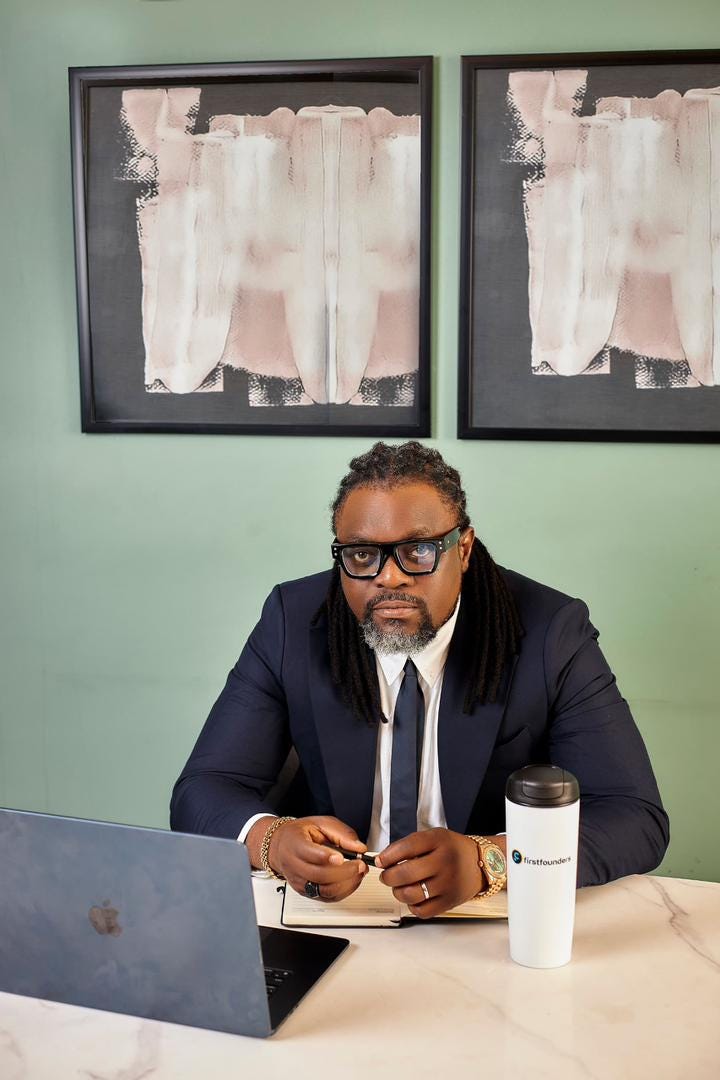
It’s 4 pm, and David Lanre Messan is just sitting down for his first meal of the day. He’s been in back-to-back meetings since morning, so we keep our cameras off while he eats.
“Don’t be surprised if I release an album next year,” he says casually, after some banter.
DLM, as he’s widely known, has always lived at the intersection of creation and execution. There was a time when he was a music artist, actor, and model — and he doesn’t believe that chapter is closed. Not yet.
Today, his creative energy is focused on a different medium: companies.
Through his venture studio, First Founders, DLM is backing entrepreneurs using a model he believes dramatically improves the odds of building successful businesses in Africa. That conviction didn’t come cheaply. He sunk $1 million of his own money into startups and learned the hard way. He has lost money, burned capital, and learned firsthand why many startups fail long before product-market fit.
The result is a clear — and sometimes contrarian — thesis on how companies should be built, and a growing scepticism of traditional venture capital.
This conversation explores the ideas, scars, and systems behind DLM’s evolution from creator to what he now calls a “company creator.”
You’ve worn many hats: artist, marketer, entrepreneur. How did your upbringing shape that range?
I was born to a teacher father and a trader mother, so I grew up with both intellectual curiosity and gritty commerce in the same house. We weren’t rich in cash, but we were rich in purpose. I watched my parents find food for neighbours even when we didn’t have much ourselves. That stayed with me — accountability, generosity, and the sense that you should solve problems when you see them.
Even though I studied Mass Communication because of my creative leanings, I didn’t wait until I graduated to start a business. I just always felt the need to build.
What was the first business you started, and when did you realise you had a knack for spotting opportunity?
In 2003, I started a small publicity business. I was paid to paste posters and share flyers. It did okay, but it wasn’t remarkable.
The real breakthrough came with my next business, an e-book business. This was before digital downloads were common. I identified a distribution problem and solved it by burning 30 categorised business books onto CDs and adding motivational music. People loved it.
I started that when I was around 22 years old. It was a classic “street-smart” venture that ran for about 3 to 4 years.
At one point, someone ordered ₦3 million worth of CDs just after hearing the idea. The margins were crazy as the CDs cost about ₦600 to produce and sold for ₦3,000. That was my first real taste of leverage. It taught me everything about supply chains, customer psychology, and the importance of distribution—lessons I still use today when building digital products.
You’ve been very open about losing money early in your journey. What went wrong?
As the business grew, I wanted to give back. I started touring schools, teaching abstinence and HIV/AIDS prevention because I noticed many young people were becoming parents earlier than they planned.
But I soon realised moral lectures weren’t enough. Young people were vulnerable because they lacked economic skills. So I shifted into entrepreneurship empowerment and started providing startup capital.
I invested anything from ₦12,000 to about ₦150,000, depending on the business — farming, trading, whatever. Over three years, I invested roughly ₦20 million across different businesses. Every single one failed. I was also scammed in a forex business.
It was youthful inexperience. I didn’t understand structure, capital efficiency, or operations.
How did that period change how you think about entrepreneurship?
It humbled me. I realised that ideas and good intentions aren’t enough. I was consulting and helping people develop business ideas, but there was no structure. No operational efficiency. No capital discipline. And because of that, many of those businesses didn’t survive.
Eventually, the CD business lost steam because competitors flooded the market, and I had to pause and reassess.
You then stepped into the corporate world. Why was that necessary for you at that stage?
Between 2009 and 2019, I needed to rebuild financially and structurally. I worked at Universal Anchor Consulting and later at Maku Sports. That period taught me discipline and how organisations actually function.
There’s a story about you closing a ₦500 million deal when others couldn’t. What happened?
At Maku Sports, the marketing team was struggling to close a deal for an international squash tournament. I stepped in and proposed mobile glass courts, which completely changed the value proposition. Before, they’d been used to playing squash in a static place, but the idea of moving the location as well was appealing to them.
And they were like, okay, yeah, that’s a great idea. And then that was it. That single move helped generate about ₦500 million in sales.
That period really confirmed that I was a closer. Over the next decade, I led sales and marketing roles, sharpening that muscle.
Yes, and you’ve kept on closing deals since then. What led you to found First Founders, and why a venture studio instead of traditional investing?
I had seen both sides — entrepreneurship without structure and structure without entrepreneurship. In 2020, I decided to combine them.
African startups don’t fail because founders aren’t smart. They fail because there’s no operational efficiency. Writing checks alone doesn’t solve that.
With First Founders, we don’t just invest. We build with founders. We provide shared resources — legal, HR, technical support — so they can survive the valley of death. I don’t see myself just as a founder anymore. I’m a company creator.

You talk a lot about capital efficiency. What does that mean in practice?
Traditional venture capital often gives money to the smartest guy — the one who can talk well — and then allows them to burn cash on big assumptions.
We do the opposite. By sharing resources across multiple startups, we cut build costs by almost 50%. What would normally take $500,000 to build can be done for about $250,000.
My business is a company creation. Our internal question is simple: Did we build a new company this week? At First Founders, we believe companies should be built every day.
Since we shifted focus to the venture studio model, we have built and supported over 10 companies directly through our studio process. We are currently scaling 6 of these.
You’ve said founders shouldn’t start with an MVP, but an MVT. Why?
Founders are told to build Minimum Viable Products, but that’s often too late. You’ve already spent money writing code.
I believe in the Minimum Viable Test. It’s at the point of MVT that you kill. You test assumptions early, before you commit serious capital.
Take Pocket Lawyers. The original idea was affordable lawyers. After four months of testing, we realised customers didn’t want affordable lawyers — they wanted fast lawyers. We pivoted before building the wrong product.
MVPs are meant to gather data and feedback, not just users. Many founders obsess over user acquisition and forget the data that actually tells them what to build next.
What we’ve done instead is build productivity tools for lawyers, while creating clear pathways that connect them to clients.
We’re still operating in the same market, but we’re solving a different problem—because the customer revealed a different need. That ability to listen and adapt is why companies built within a venture studio tend to survive longer.
You’ve linked entrepreneurship to the fight against brain drain. How so?
Entrepreneurship is the only real defence against japa. If the smartest young people leave, the continent is left with crumbs.
My goal is to democratise entrepreneurship — not just to create wealth, but to create opportunity. If we can build a factory of companies, staying in Africa becomes a viable choice for the next generation.
You’re still creating outside of business. Why does storytelling matter to you?
I’m still an active creator. I wrote a fiction book, Spells and Spectacles, and I’m working on a novel about the tech ecosystem. Storytelling helps me make sense of the chaos of business. It’s how I process the world.
Rapid Fire 🔥
What’s one idea about leadership you’ve had to unlearn?
The biggest idea I’ve had to unlearn is that “A leader must have all the answers.”
Early on, I thought leadership was about being the smartest person in the room and giving directions. I’ve had to unlearn that and replace it with the idea that leadership is about creating a safe environment for others to find the answers. Now, I focus more on asking the right questions rather than providing all the solutions.
What’s a decision that looked wrong in the moment but proved right over time?
Deciding to pivot away from traditional consulting to focus on the Venture Studio model looked “wrong” to many people at the time. We had a steady stream of consulting revenue, and moving toward a model where we take equity and “build” alongside founders felt risky and slower to monetise. In the moment, it looked like I was turning away “sure money” for a long-shot bet. Over time, however, it proved right because it allowed us to build actual assets and deep institutional knowledge that consulting alone never could.
What’s a book or movie that shaped your thinking?
The Book: Blue Ocean Strategy by W. Chan Kim and Renée Mauborgne. It completely shifted how I view competition. Instead of fighting for space in “red oceans” (crowded markets), I focused on creating “blue oceans”—entirely new markets where competition is irrelevant. This is a core pillar of how we approach business at FirstFounders.
The Movie: The Pursuit of Happiness. It’s a cliché for a reason. It reinforced the “never give up” DNA that is required when you are building something from nothing in an environment like Nigeria.
📡 The Questing Takeaway
DLM’s evolution proves that in a volatile market, systems beat hype. Whether it was selling CDs in 2003 or building a “company factory” today, his edge is structure.
The Lesson: Don’t build an MVP on hope. Run a Minimum Viable Test (MVT) to gather the data that proves you should build at all.
What’s one assumption you can test for $0 this week? Reply and let’s discuss.